The rapid expansion of urbanization and industrial activities has intensified global waste management challenges. Traditional landfill disposal remains one of the most widely used methods for handling municipal and industrial waste, yet it creates long-term environmental burdens. Limited landfill capacity, methane emissions, soil contamination risks, and increasing operational costs are forcing industries and governments to seek more sustainable waste treatment technologies.
A high-efficiency Beston pyrolysis plant provides an advanced solution by converting various waste materials into valuable resources through controlled thermal decomposition. This technology reduces the volume of waste requiring landfill disposal while creating renewable products such as fuel oil, combustible gas, and carbon-rich materials.
Addressing the Growing Challenge of Landfill Overload
Landfills occupy extensive areas of land and require continuous expansion as waste generation increases. Materials such as waste tires, plastic residues, oil sludge, and biomass waste often degrade slowly, creating persistent ecological concerns. Once deposited, these materials can remain in landfill environments for decades.
Pyrolysis technology offers a resource-oriented alternative. Instead of permanently storing waste underground, the process breaks down organic compounds in an oxygen-deficient environment. The high-temperature reaction separates complex materials into reusable fractions. As a result, waste streams are transformed from disposal liabilities into industrial feedstocks.
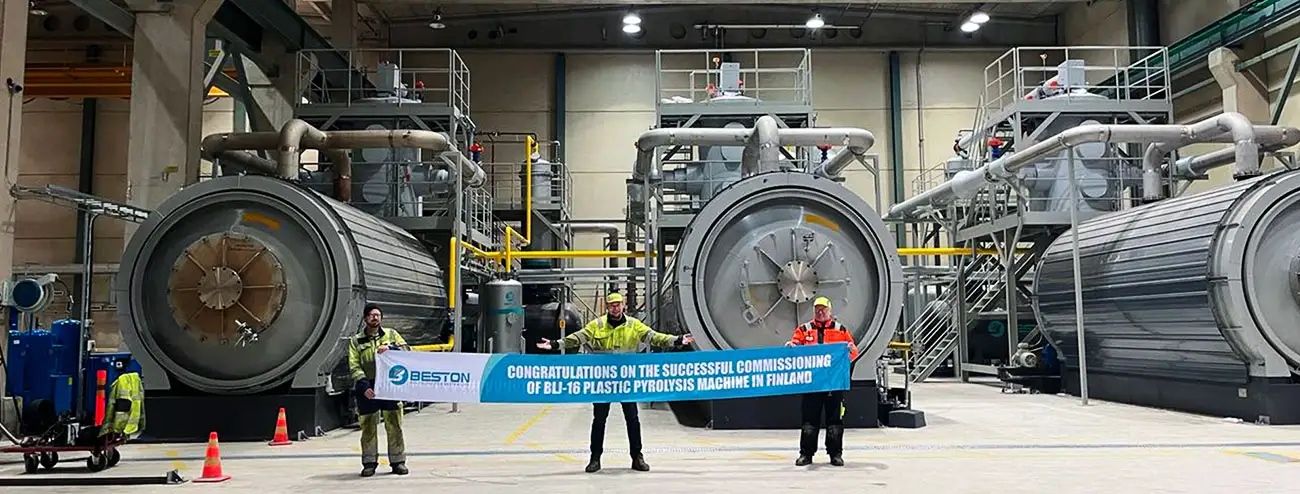
The Beston pyrolysis plant integrates advanced thermal processing principles with efficient waste conversion mechanisms. Its optimized reactor design improves heat distribution and enhances material decomposition, allowing operators to process large quantities of waste with improved energy utilization.
 |
Advanced Thermal Conversion for Sustainable Waste Management
The core principle of pyrolysis is thermochemical conversion. Under controlled heating conditions, organic materials undergo molecular restructuring without direct combustion. This reduces harmful emissions associated with traditional incineration while maximizing resource recovery.
A modern pyrolysis system typically includes feeding units, a heating chamber, condensation equipment, gas purification devices, and discharge mechanisms. Each component contributes to stable operation and higher conversion efficiency.
The Beston pyrolysis plant is engineered with automated control systems that regulate temperature, pressure, and processing conditions. This intelligent configuration helps maintain consistent output quality while reducing manual intervention. Furthermore, the recycling of non-condensable gas generated during operation improves energy efficiency by providing supplementary heat for the pyrolysis process.
Reducing Waste Volume and Environmental Impact
One of the most significant advantages of pyrolysis technology is its ability to dramatically decrease landfill dependency. Waste materials that would otherwise require extensive storage can be converted into useful products with commercial value.
For example, waste tires processed through pyrolysis can produce oil, carbon black, and steel wire. Plastic waste can be transformed into fuel resources, while biomass residues can generate biochar with applications in soil improvement and carbon management.
By minimizing the amount of residual waste sent to landfills, pyrolysis contributes to more efficient land utilization. It also supports circular economy strategies by extending the lifecycle of discarded materials. This transition represents a shift from conventional waste disposal toward regenerative resource management.
Economic Benefits of High-Efficiency Pyrolysis Technology
Beyond environmental advantages, high-efficiency pyrolysis equipment provides economic opportunities. Waste treatment facilities can generate additional revenue streams by recovering valuable byproducts. Fuel oil can serve as an industrial energy source, carbon materials can be used in manufacturing applications, and recovered metals can enter recycling markets.
The Beston pyrolysis plant is designed to support continuous and stable operation, improving productivity for commercial-scale waste processing projects. Its adaptable structure allows different waste materials to be handled according to specific operational requirements.
Energy recovery, reduced landfill fees, and resource utilization together create a more sustainable financial model for waste management enterprises.
Future Development of Waste-to-Resource Solutions
As environmental regulations become stricter and landfill availability decreases, advanced conversion technologies will become increasingly important. Pyrolysis represents a practical pathway for addressing waste accumulation while supporting renewable resource development.
High-efficiency systems combine engineering innovation, emission control, and material recovery into a comprehensive waste treatment framework. The application of the Beston pyrolysis plant demonstrates how modern technology can transform waste management from a disposal-focused approach into a value-generation process.
Reducing landfill pressure requires solutions that consider both environmental protection and industrial feasibility. Through efficient thermal conversion and resource recovery, pyrolysis technology provides a scalable method for building cleaner waste management systems and promoting long-term sustainability.


No comments:
Post a Comment